Showing posts with label Great Egret. Show all posts

Wednesday, May 25, 2011

Back to Birding...


I have been itching to get out with the camera lately, and today I finally pushed myself a bit and went out to photograph birds.   I did not have my usual stamina, and found that I had to stop and take a rest every hour or so.  But it was nice to get outdoors and once again occupy myself with something I really enjoy doing.

I was able to get a few decent photos, including one of a roseate spoonbill chick.  Prior to today I did not have any images of chicks of this particular species, and it was difficult to get this one due to twigs and branches obstructing my view to the bird as it hobbled around in the nest.  But waiting and watching for quite some time finally paid off and resulted in the image below.  You can contrast this image with of the adult spoonbill below it.


Roseate Spoonbill - chick

Roseate Spoonbill - adult

The next image is a cattle egret in full breeding plumage.  It's quite amazing how a fairly boring white bird transforms itself into the colorful version you see below in breeding season.

Cattle Egret in breeding plumage


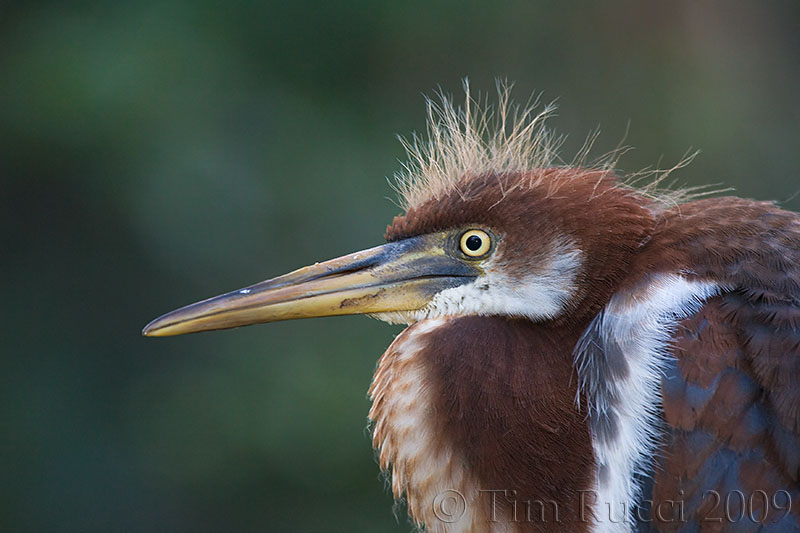
Next is a young tricolor heron.  As the bird gets older, the browns will turn to blues as seen in the top image in this article.


Tricolor Heron - juvenile

Finally a great white egret both perched and in flight.


Great White Egret


Saturday, January 29, 2011

Reworking Old Photos


Night Heron in Flight (juvenile) 2005

[Click on any image for a larger view]
 It seems as software gets more and more sophisticated and one's editing skills improve, there is always a desire to go back and re-edit old photos.  On that topic, I often tell my friends that I don't think any of us will live long enought to go back and fix all of the images we'd like to fix.  But accepting that as reality, it's still fun to take some time now and then to dabble a little bit just to see the difference between our editing skills now, versus what they were back whenever.

I have been cleaning up some old computer files this weekend and deleting a lot of old images that I no longer feel are worth holding onto.  But in that process I stumbled across a few photos I couldn't resist taking time to rework.

I've been using Photoshop CS5 since it was released a last year and I believe it is absolutely the best upgrade Adobe has ever released in the CS line of software.  Adobe Camera Raw version 6 (raw image editor) is absolutely amazing compared to even the last version that preceded it.  The improvements in ACR alone make CS5 worth the upgrade price. 

The first image above of a juvenile night heron in flight, is a lucky shot I made back in 2005 with my first ever DSLR, a Canon 10d.  It typically could not focus fast enough to track a moving bird, but I got lucky on this attempt.  This is still one of my favorite shots of all the birds in flight I have photographed since.

Here are a few images I reworked today...


Tricolor Heron in breeding plumage, 2009
 

Red Shoulder Hawk, 2008


Yellow Crowned Night Heron, 2010


Meadowlark, 2008


Wood Stork (nest building), 2009


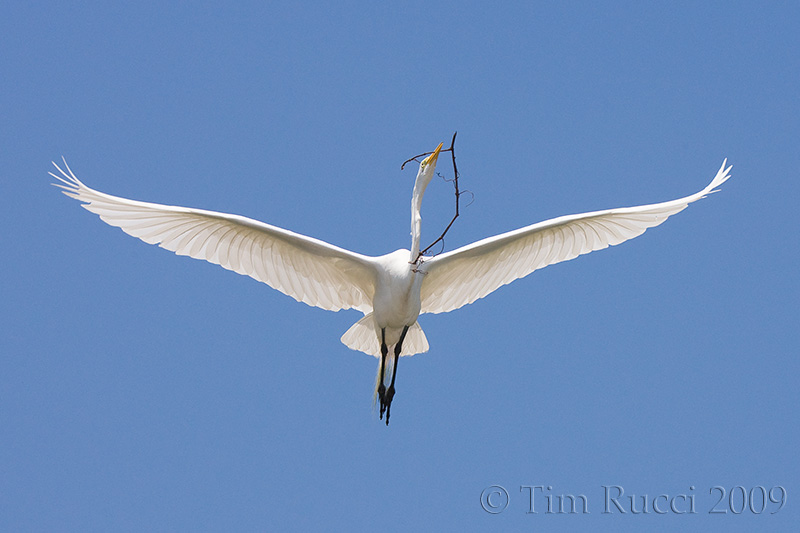
Great Egret with nesting material, 2009


Friday, April 2, 2010

Birds In Flight

St. Augustine Alligator Farm
Having just returned last week from a trip around Florida photographing birds, I was still in the mood to do a little more.   So on Tuesday I drove down to the rookery at the St. Augustine Alligator Farm and was a little surprised to see so many birds already nesting in the trees above the swamp.   I had heard there were a good number of birds, but never expected this many so early in the season.  

Needless to say, this made a good opportunity to photograph some birds in flight.  The wind direction was not ideal, but I still got some decent opportunities.   There were tons of great egrets, and also lots of wood storks and snowy egrets. 

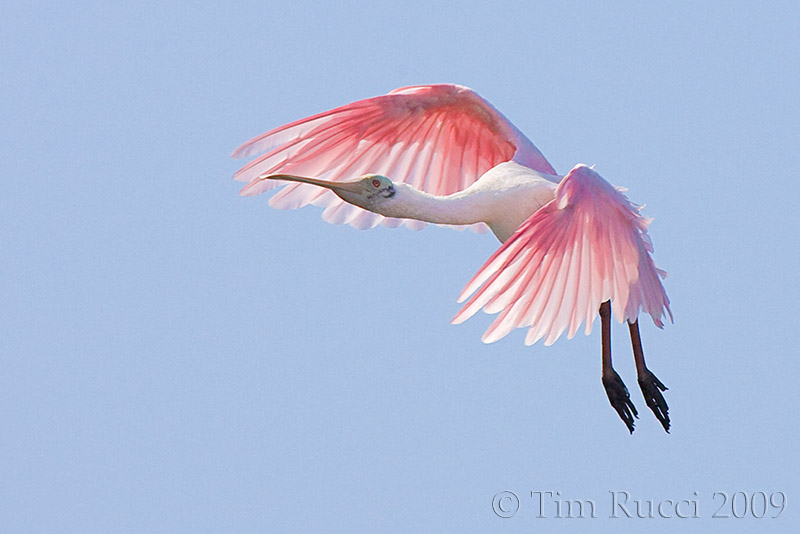
I also saw about 20 spoonbills roosting, and occasionally they would fly around.  But usually they did not fly far and would land again close to whee they had been, offering little chance of flight photographs.   I only had one or two chances to photograph the spoonies in flight, and I didn't really get anything too good.   The image above is one of them. [click any image to enlarge]

The next five images are great egrets.  It's fun to photograph these guys as they go out to retrieve sticks and then return to add them to the nest.


Below is one of the few wood storks I photographed that day.  There were lots more great egrets in the sky than anything else. 
 

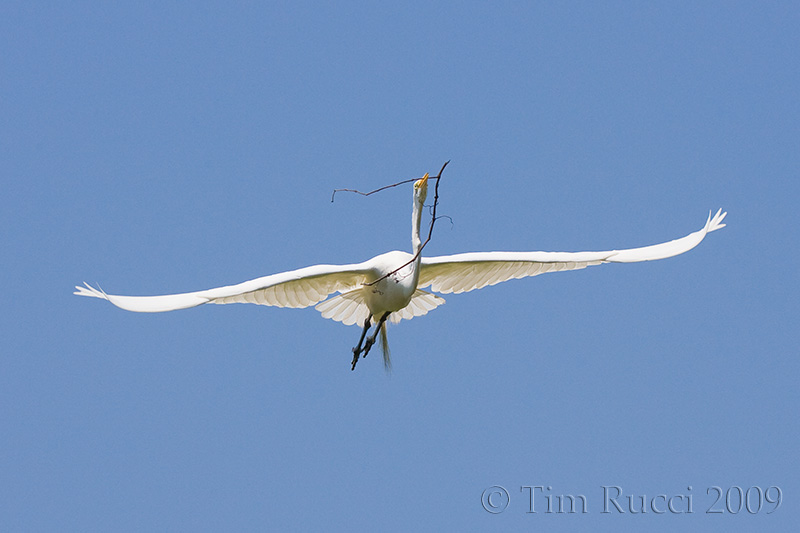
And finally, it was interesting to see this great egret below attempt to fly with this large a tree branch.  He flew a good distance with the branch, but dropped it just as he got to the nest.

The rookery is really cranking up now and there are lots of birds.  In addition to what I've already mentioned, there were also some tricolor herons and a few cattle egrets, and night herons. 

The newly built boardwalk is much nicer than the old one.  It is far more stable, and it extends a little closer to the back fence.  It does not vibrate when folks walk past pushing baby strollers, as it always did in the past.

I figure I'll be making a few more trips to the rookery as the other species of birds start nesting.

Wednesday, June 10, 2009

A Break from the Rain

Florida Birding

The heavy rain has finally let up, so now we are just getting our typical Florida summertime afternoon showers. This gave me the opportunity to go out shooting again, and I enjoyed spending the morning at my favorite venue. But it is really getting hot - the temperature topped out just over 90-degrees F yesterday, and it is expected to get worse. You can tell summer is on its way, although it has not officially arrived.
Below are some photos from my latest outing, including a few headshots and a great egret flight sequence.

[click on any image to enlarge]
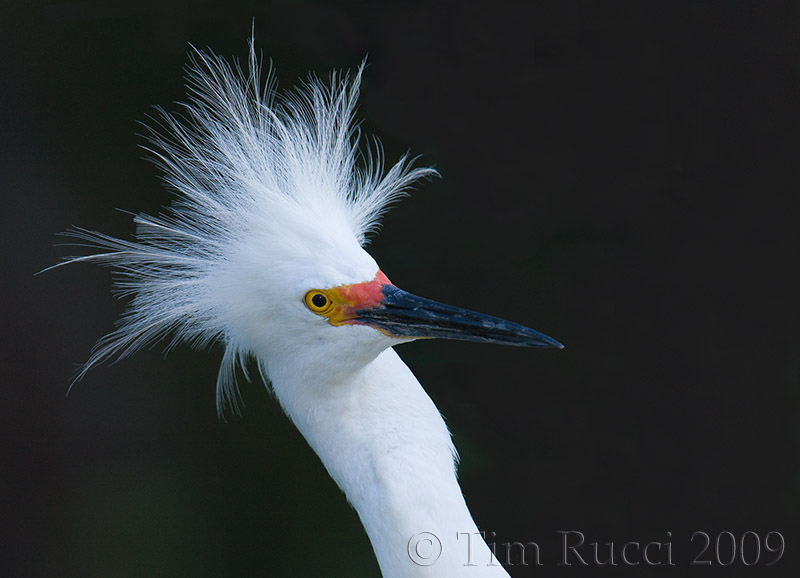
6791c - Snowy Egret
This snowy egret photo is probably my favorite shot of the day. It was made with my backup camera, a Canon 40d with 300mm f2.8 lens and 2x extender (600mm). I've heard people say for a long time that the 2x extender degrades picture quality too much to be of use. I used to think that was true, but I realized last year that my camera focus was out of calibration, and once that was corrected, I began to get nice images, even with the 2x. I might add that to get good results with an extender, you should attach it to a good quality lens.

The tricolor heron below is a young bird, as you can tell by the coloration and the head feathers.
66424 - Tricolor Heron
There were a good number of roseatte spoonbills (15 to 20), but they were roosting in the trees and seldom flying around. Every so often a few of them would get restless and fly off to a different perch. I was not able to get many good flight photos of them because I either was not close enough or the light was at a bad angle. Here is one shot I managed to get, although pretty heavily cropped.

66577c - Roseatte Spoonbill

66606 - Snowy Egret
Snowy egrets were flying around jousting for space in several trees, and I captured this image when one of them held still for a few seconds. Most of the time, the snowy egrets did not stay put for very long, except for the ones sitting on eggs.


66651c - Tricolor Heron

I do not have many tricolor heron flight shots, so if I get an opportunity I always try to capture a better one. I snapped several photos as this one flew past, and
this was my favorite one.
Below is a flight sequence of a great egret flying to the nest with a stick. I watched as the bird tore the branch from a tree, and then prepared to fly back to the nest. I like the first and last shots the best. It's interesting to watch as the bird springs off the tree and spreads its wings to take off.

#66627 - 66631 Great Egret flight sequence
66628
66629
66630
66631

Thursday, April 30, 2009

Birding Nirvana

Photographing Birds in Flight

On Tuesday I went out with the intention of getting some bird images and testing my camera that was just back from Canon sporting a brand new shutter. In my previous post, I used my backup camera and was pleasantly surprised at how well it tracked moving birds.

63622 Roseatte Spoonbill 1/3200, f5.6, +2/3EV
But this day I was happy to have my main rig back in my hands, and I also took the 40d just in case. I set out early to drive to my venue of choice, the rookery at the St. Augustine Alligator Farm, which is about an hour away. This day would prove to be the best day ever for flight photos. The conditions were nearly perfect and the birds were so numerous that often I had to choose which one to follow and shoot. If there is such a thing as birder's nirvana, this must have been it. In this post I will show camera settings on each photo for the benefit of anyone who might be wondering. All photos in this post were shot with a Canon 1D-Mk2N body and 100-400L IS lens at iso 400. Aperture and shutter speed, as well as exposure compensation (if applicable) are shown above each photo. If exposure compensation is not shown, the photo was shot in full manual mode. Near the bottom of this post, I have shared some additional shooting tips for birds in flight.

I started off looking for an opportunity to photograph some perched birds, but I quickly abandoned that idea when I realized that there was such an abundance of flyers. To me, flyers are the ultimate challenge and I find it difficult NOT to try and photograph them, especially when the conditions are good and the backgrounds are sweet. Most of the morning, I was fortunate to have both.

63837 Great Egret 1/2500, f7.1
By the mid-afternoon, I had shot about 800 images, which is very unusual for me. Normally I will shoot till noon at the latest, and generally will end up with less than half that number. But the action was non-stop and I took advantage of it.

63594 Wood stork 1/2000, f5.6, +2/3EV
I watched as this wood stork repeatedly flew to a tree to rip off a branch, then carry it back to the nest. I loved the look of the wing spread just before he took flight. Below is another shot of him flying with a different branch.

63602 Wood Stork 1/1600, f5.6, +2/3EV
As is usually the case, there were more great egrets in the air than any other species. I did try to capture a cattle egret and snowy egret flyer, but the opportunities were rare. I was fortunate to capture a few shots of roseatte spoonbills in flight, mainly because I just happened to notice them coming before they got too close. There were only two or three chances to get spoonie flyers all day. My favorite shot was the first one posted at the beginning of this post above. The shot below is of a younger bird.

63560 Roseatte Spoonbill 1/1250, f5.6, +1EV
63664 Great Egret 1/2500, f6.3
The next few images are great egrets. I had a blast photographing these guys and even though I felt like I was taking a lot of shots that were almost identical, I never tired of doing it. I had a nice conversation with another bird photographer while I was shooting, and after a while learned that he is Kevin Karlson. Kevin has published several books on bird photography, and you can see his website HERE . Since we were both shooting right next to each other, we got many almost identical shots, and we had fun comparing them on our cameras.
63638 Great Egret 1/2000, f7.1, +2/3EV
63654 Great Egret 1/2500, f6.3
63552 Great Egret 1/2000, f5.6, +1EV
When I am shooting birds in flight, I find that it's generally best to shoot in full manual mode, but sometimes I also use aperture priority. No matter what exposure program you choose, you always have to overexpose the shot by about 2/3 to 1 stop if shooting against a bright sky background. Otherwise you will end up with a dark silhouette instead of a well exposed bird. If shooting white birds against dark foliage, the exact opposite is true and you must underexpose by approximately the same amount. The advantage of using full manual is that you can take a few test shots and set the exposure, and it will be the same no matter what the background. This eliminates the need to keep changing the exposure compensation depending what the background is. Since you never know exactly where the bird is going to fly, manual mode yields a lot more keepers and far fewer missed opportunities. I also prefer using flash rather than relying only on natural light. What I try to do is use just enough flash to fill the shadows, but not so much that the viewer can easily tell that flash was used.

63655 Great Egret 1/2500, f6.3
63693 Snowy Egret 1/2000, f7.1


63995 Snowy Egret 1/2500, f7.1
63833 Tricolor Heron 1/2500, f7.1
I was hoping to get a nice shot of a tricolor heron in flight, but unfortunately the only decent shot I think I got was this one looking almost straight up. Perhaps I'll get a better opportunity at a later time. I was not especially crazy about the wing position of the great egret shot below, but other than that I love the detail and sharpness. I am posting a 100% crop below the full shot, so you can get an idea of what I am seeing on my monitor.

63724 Great Egret 1/2500, f7.1
63724 Great Egret 100% crop
Snowy egrets and cattle egrets always seem to fly very erratically compared to the larger great egrets. This makes capturing a flight shot especially challenging. On this outing, I only saw 2 or 3 cattle egrets building nests, so the chances were limited. The shot below was my best effort.

64128 Cattle Egret 1/2500, f7.1
Shooting birds in flight is great fun, and it's also rewarding when you have a good day. I've had my share of frustrating days in the past, but this particular outing made up for a lot of them. This is the kind of day that keeps me coming back.