Showing posts with label birds in flight. Show all posts

Saturday, October 19, 2013

Alaska: Bald Eagle in Flight


On my recent trip to Alaska, I finally had a decent opportunity to photograph a bald eagle in flight. This was my 4th trip to Alaska but ironically I had never had this  opportunity before.  This is mainly because I had not spent much time in the coastal areas of Alaska.   As we all know, if you want to see a specific bird or other animal, the best plan is traveling to where its food supply is.  Since eagles mainly feed on fish, your best chances are in coastal areas. 

On this occasion I was in Homer Alaska, which bills itself as the halibut capital of the world.   One evening I saw an eagle up on a perch in a light falling drizzle in less than perfect light.  The daylight was also waning as I waited nearly an hour to see if the eagle would leave its perch.  Every few minutes I would take a test shot to meter the light and ensure that I would nail the exposure in the event the eagle would take flight and gave me the opportunity that so far had evaded me.   I was about ready to give up when the eagle started to move and raise some optimism that it would soon fly.

I was shooting in manual exposure mode to ensure that the camera would not try to adjust the exposure as the color of the background changed.  Having the camera automatically adjust the exposure when using aperture priority or shutter priority modes will result in incorrect exposures and lost shots if the color of the background changes.  As long as the general level of light is not getting brighter or darker, manual exposure is the best approach to this type situation.  While I waited, the correct exposure ranged from +1EV to about +1.67 or +2EV by the time the eagle flew.  To get the correct exposure I had to overexpose the shots about 2-stops compared to what the camera metering system thought was the correct exposure.  The white background filling at least 3/4 of the frame compared to the dark colored bird was fooling the metering system.  So the photographer must trust the histogram if he intends to get the true, correct exposure.

For this entire series of images, the settings were 1/1600 @f4, iso 1600, (+2EV) with Canon 1DX camera and 500L f4 IS lens.

The eagle finally launched itself and I was firing immediately from the start.  I seldom if ever shoot long bursts, but this was an occasion where such action was warranted.  I knew it might be difficult to keep my focus sensor pattern trained on the eagle as it flew, so I used settings that caused the camera to delay searching for the subject in the event the focus sensors were not on the bird the entire time as I attempted to track its flight.

I ended up firing a burst of 37 consecutive shots in a period of just over 3 seconds.  I managed to track the eagle relatively well through the flight and only lost focus as the bird banked and flew over my head.  Upon reviewing the images on the rear LCD of my Canon 1DX, I found that about 32 of the 37 shots were tack sharp, and 2 or 3 more were acceptably sharp.  The 2 shots that were unusable were the last 2 in the sequence where I no longer had the focus sensor pattern on the bird as it flew past me.  (in other words, the 2 unusable shots were my fault, not the camera's).

With birds in flight, it's always good to have lots of in-focus shots so one can pick out the most flattering images with the most appealing wing positions.   I chose several from this sequence and posted them below.  

You can see more images from this trip on my website here:
http://www.pbase.com/tim32225/alaska_2013

Please feel free to click on the link above and take a look.


Friday, January 11, 2013

Great Blue Heron - Nest Building

It's been a few months since I've posted anything here, but lately I have gathered some new material so finally I have some images to share.  I recently treated myself to a new camera, and the images in this post were gathered while trying it out for the first time at a couple of my favorite venues for bird photography.  

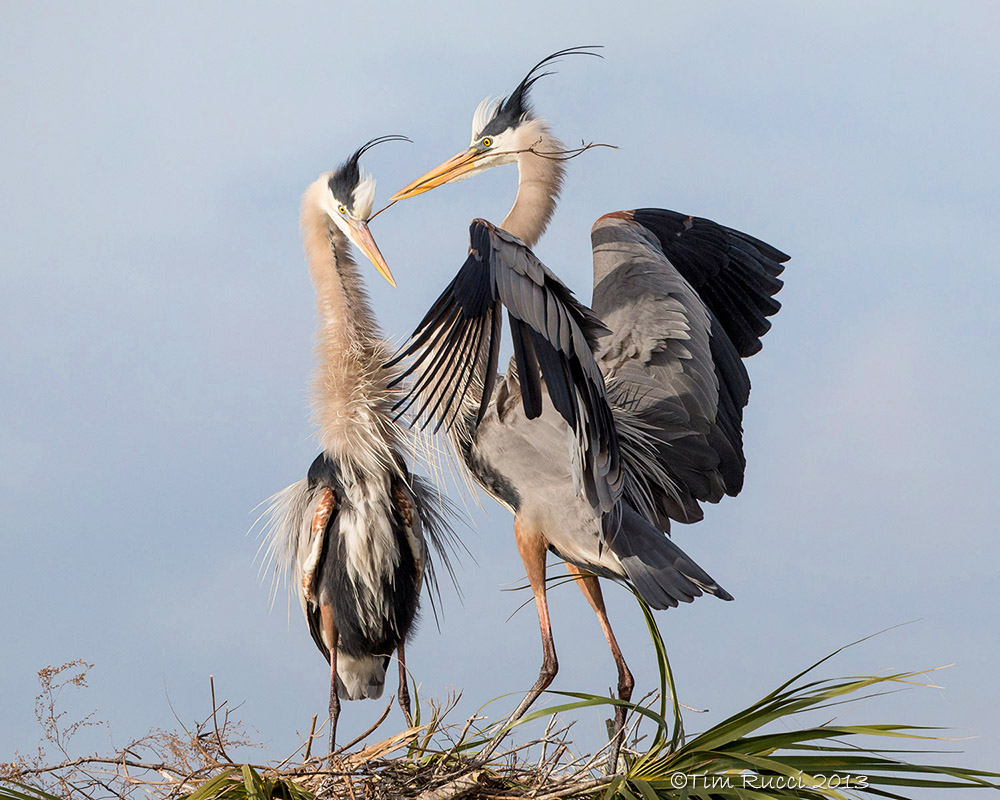
Male heron handing a twig to the female
1/3200 @f10, iso 3200, 700mm

The camera is a Canon 1Dx and I so far am very pleased with it. I was shooting a Canon 1D Mark 4 prior to this and now that camera will serve as a very capable backup.  The 1Dx is absolutely the fastest, most responsive camera I have ever held in my hands.  The speed and accuracy of focus acquisition is simply amazing, even compared to the Mark 4.  I am confident that this camera will serve me well on my coming trip to Kenya.  
 
1DX_0687 Male heron gatering sticks
1/320 @f7.1, iso 800, 700mm
 
 
Last week I tried out the camera at Merritt Island National Wildlife Refuge, and Viera Wetlands, about 30 miles further south. There was not much bird activity at Merritt Island the first day but a trip down the road to Viera proved to be very productive. There were several pairs of great blue herons building nests, and as you have probably already realized, they are the subject of this post.                            
 
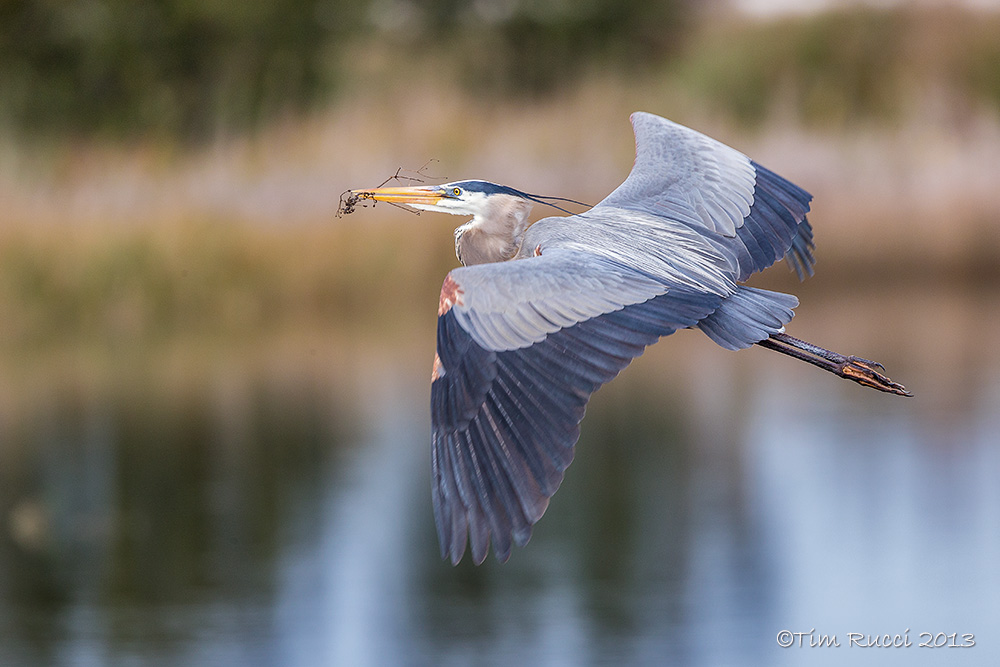
1Dx_0669  Male flying back to the nest
1/640 @f7.1, iso800, 700mm 
 
 
 I had observed great blue herons nest building on prior occasions, and discovered that their behavior is very predicatable. The male repeatedly flies to and from the nest, gathering twigs and handing them off to the female. The female then places each twig exactly where she wants it in the nest. This process repeats itself over and over so it is not too difficult to get in a good position to photograph it.
 
1Dx_0733 Male heron flying back to the nest
1/5000 @f10, iso 1600, 700mm
 
About every 5 minutes or so, the male would leave the nest and fly off to find aother twig.   It would only take about a minute for him to find one and then fly back to the nest. 
 
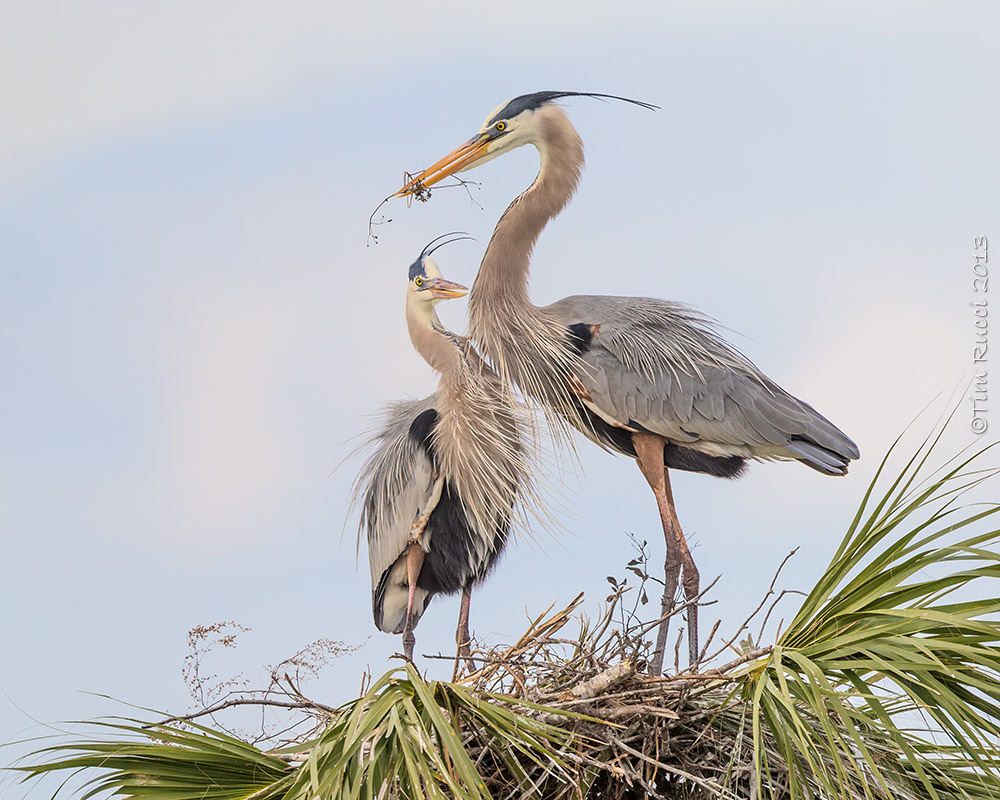
1Dx_0672  Male heron landing in the nest
1/1250 @f7.1, iso 800, 700mm
 
1Dx_ 0680   Male heron preparing to hand the twig to the female
1/1250 @f7.1, iso 800, 700mm
 
Typically in just a few minutes, the male is flying away again to gather more nesting material. 
 
1Dx_0725  Male heron headed out to find nesting material
1/4000 @f10, iso 1600, 700mm


Saturday, January 29, 2011

Reworking Old Photos


Night Heron in Flight (juvenile) 2005

[Click on any image for a larger view]
 It seems as software gets more and more sophisticated and one's editing skills improve, there is always a desire to go back and re-edit old photos.  On that topic, I often tell my friends that I don't think any of us will live long enought to go back and fix all of the images we'd like to fix.  But accepting that as reality, it's still fun to take some time now and then to dabble a little bit just to see the difference between our editing skills now, versus what they were back whenever.

I have been cleaning up some old computer files this weekend and deleting a lot of old images that I no longer feel are worth holding onto.  But in that process I stumbled across a few photos I couldn't resist taking time to rework.

I've been using Photoshop CS5 since it was released a last year and I believe it is absolutely the best upgrade Adobe has ever released in the CS line of software.  Adobe Camera Raw version 6 (raw image editor) is absolutely amazing compared to even the last version that preceded it.  The improvements in ACR alone make CS5 worth the upgrade price. 

The first image above of a juvenile night heron in flight, is a lucky shot I made back in 2005 with my first ever DSLR, a Canon 10d.  It typically could not focus fast enough to track a moving bird, but I got lucky on this attempt.  This is still one of my favorite shots of all the birds in flight I have photographed since.

Here are a few images I reworked today...


Tricolor Heron in breeding plumage, 2009
 

Red Shoulder Hawk, 2008


Yellow Crowned Night Heron, 2010


Meadowlark, 2008


Wood Stork (nest building), 2009


Great Egret with nesting material, 2009


Thursday, April 29, 2010

Roseate Spoonbills

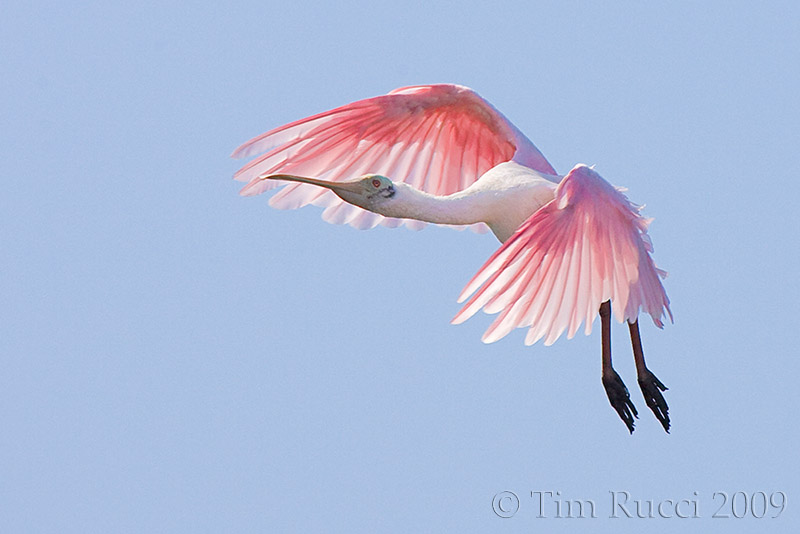
One bird that seems to usually be pretty elusive for me is the roseate spoonbill.  I don't see a lot of them very often, and usually when I do the chances of good photos are slim.  When the birds are roosting, the backgrounds are almost always too cluttered so the best chance at a keeper is usually a flight shot.   This presents a whole different set of challenges because it seems that I seldom get many opportunities at flight shots either.  Even when I do, everything has to be just about perfect to get a decent photo.   The light needs to be in the right direction, and a small amount of flash should be used to partially light up the underside of the wings to balance the ambient light hitting other parts of the bird.  If all these factors are in place, then the challenge is to capture a good flight pose and also get a sharp, well focused image.    The majority of my attempts end up in the recycle bin due to one or more of the items mentioned above not being just right, but most often due to just not capturing an attractive pose.


On my most recent outing, I hooked up with a friend who was visiting Florida from Texas and we set out to try and get some flyer shots.   I had some decent opportunities with various bird species, including two chances where a roseate spoonbill flew close by.   I am only including the spoonbills in this post and all of these flight shots came from the same series.    In the image above, the bird was flying to the left and preparing to bank back toward the right. 


As the bird came back around to the right, I was fortunate to get a shot with a full wingspread.  Although the flash did not fire, I got a little bit lucky that the wings were back lit enough to prevent the underside from being too dark.   When I checked the exif data on this series of photos, I was surprised when I noticed that flash did not fire on any of them.   Thinking back, I remember changing my flash batteries at one point after discovering they were spent.  I must have shot this sequence prior to that time.  I must remember to watch that indicator more closely from now on as I believe some fill flash would have helped these images.  

As yet, this species has not nested this far north in Florida. But folks around here are hopeful that they may start soon as some nesting behaviours have been observed in St. Augustine.

In a bit of unrelated news, I was fortunate to get NASA Causeway tickets again for  the launch of Space Shuttle Atlantis on May 14.   So if all goes well and there no delays, I am hoping to get some better images of a shuttle launch in a couple weeks.  This will be the last flight of space shuttle Atlantis, and after this there are only 2 more launches left in the entire shuttle program.  I'm sad to see the program end.

Friday, April 2, 2010

Birds In Flight

St. Augustine Alligator Farm
Having just returned last week from a trip around Florida photographing birds, I was still in the mood to do a little more.   So on Tuesday I drove down to the rookery at the St. Augustine Alligator Farm and was a little surprised to see so many birds already nesting in the trees above the swamp.   I had heard there were a good number of birds, but never expected this many so early in the season.  

Needless to say, this made a good opportunity to photograph some birds in flight.  The wind direction was not ideal, but I still got some decent opportunities.   There were tons of great egrets, and also lots of wood storks and snowy egrets. 

I also saw about 20 spoonbills roosting, and occasionally they would fly around.  But usually they did not fly far and would land again close to whee they had been, offering little chance of flight photographs.   I only had one or two chances to photograph the spoonies in flight, and I didn't really get anything too good.   The image above is one of them. [click any image to enlarge]

The next five images are great egrets.  It's fun to photograph these guys as they go out to retrieve sticks and then return to add them to the nest.


Below is one of the few wood storks I photographed that day.  There were lots more great egrets in the sky than anything else. 
 

And finally, it was interesting to see this great egret below attempt to fly with this large a tree branch.  He flew a good distance with the branch, but dropped it just as he got to the nest.

The rookery is really cranking up now and there are lots of birds.  In addition to what I've already mentioned, there were also some tricolor herons and a few cattle egrets, and night herons. 

The newly built boardwalk is much nicer than the old one.  It is far more stable, and it extends a little closer to the back fence.  It does not vibrate when folks walk past pushing baby strollers, as it always did in the past.

I figure I'll be making a few more trips to the rookery as the other species of birds start nesting.

Tuesday, March 23, 2010

Birding in Florida - Part 1

Merritt Island National Wildlife Refuge
Last week my friend Ken Conger was planning to visit so we could photograph the launch of Space Shuttle Discovery.  Ken has been wanting to see a launch for some time, so I am bummed (and surely so is he) that the launch has been delayed until at least April 5th.   We decided to spend the time visiting some wildlife sanctuaries instead, so we set out a plan based on some target species we both wished to photograph.   We started out at Merritt Island National Wildlife Refuge, where we had hoped to photograph skimmers and reddish egrets.   There was an abundance of roseatte spoonbills there also, which is one of Ken's favorite species.   

I had for a long time wanted to capture a photograph such as the one above, and found it challening to do, since a bit of luck is involved in finding a place to shoot where the birds are likely to fly past in close proximity.   You can see a closer look at the beak action in the water in the image crop immediately above.  [click on any image to enlarge]

While in the wildlife refuge, I was pleased to  have the opportunity to meet up with up with fellow birder Rod Ostoski , whom I had gotten to know through email the last few years, but had never actually met.  Rod showed Ken and me some good places to watch for skimmers, and I'm pretty sure I would not have gotten the skimmer shots posted here without his direction.   Rod is probably best known for has amazing images of the space shuttle.  You can see them, as well as many bird images on his website linked above.  It was Rod who helped me out with some initial camera settings for photographing the space shuttle launches on several attempts I have made in the past.

One of my favorite images from this trip was a great blue heron that we sort of happened upon when we rounded a bend on Biolab Road.  I shot the image at left from the car, fearing that the bird would fly if I tried to get out.   This guy was in perfect light on smooth water, and I was able to fill the frame with the 100-400 lens I had on my 40d backup rig in the front seat.

I made a very similar image of a tricolor heron, although the bird was not as close as the great blue and had to be cropped.  The light and reflection looked amazing, and I patiently waited for the bird to turn into the soft early morning sunlight before taking this shot.   I already have lots of images of tricolor herons, but none that I remember in water like this one.

One species I had hoped to see is a white morph reddish egret.  Unfortunately I did not see one all week, but did have the opportunity to photograph the reddish egret shown below as it fished along the shoreline.


The day would not be complete without some flyers, so I have included a few below.  There were an abundance of white ibises and roseatte spoonbills.
CLICK HERE  to continue to Part - 2.

You can also check out my Birds in Flight  gallery here.

Wednesday, June 10, 2009

A Break from the Rain

Florida Birding

The heavy rain has finally let up, so now we are just getting our typical Florida summertime afternoon showers. This gave me the opportunity to go out shooting again, and I enjoyed spending the morning at my favorite venue. But it is really getting hot - the temperature topped out just over 90-degrees F yesterday, and it is expected to get worse. You can tell summer is on its way, although it has not officially arrived.
Below are some photos from my latest outing, including a few headshots and a great egret flight sequence.

[click on any image to enlarge]
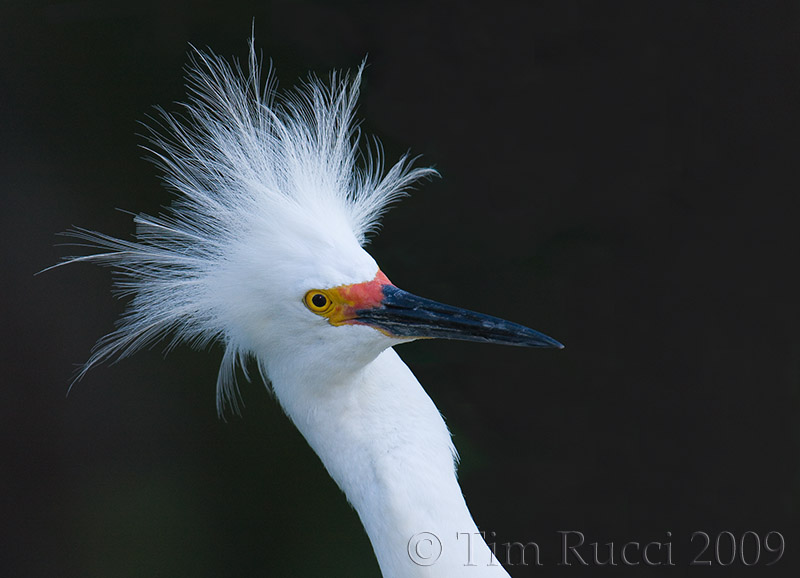
6791c - Snowy Egret
This snowy egret photo is probably my favorite shot of the day. It was made with my backup camera, a Canon 40d with 300mm f2.8 lens and 2x extender (600mm). I've heard people say for a long time that the 2x extender degrades picture quality too much to be of use. I used to think that was true, but I realized last year that my camera focus was out of calibration, and once that was corrected, I began to get nice images, even with the 2x. I might add that to get good results with an extender, you should attach it to a good quality lens.

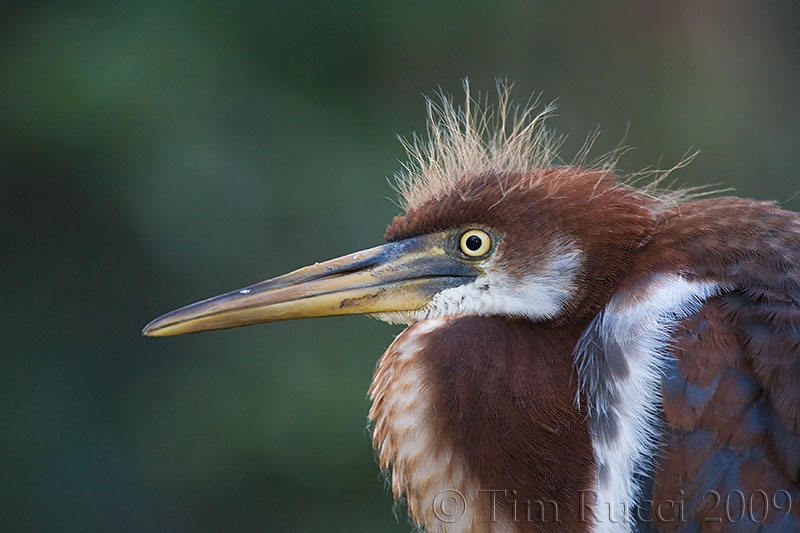
The tricolor heron below is a young bird, as you can tell by the coloration and the head feathers.
66424 - Tricolor Heron
There were a good number of roseatte spoonbills (15 to 20), but they were roosting in the trees and seldom flying around. Every so often a few of them would get restless and fly off to a different perch. I was not able to get many good flight photos of them because I either was not close enough or the light was at a bad angle. Here is one shot I managed to get, although pretty heavily cropped.

66577c - Roseatte Spoonbill

66606 - Snowy Egret
Snowy egrets were flying around jousting for space in several trees, and I captured this image when one of them held still for a few seconds. Most of the time, the snowy egrets did not stay put for very long, except for the ones sitting on eggs.


66651c - Tricolor Heron

I do not have many tricolor heron flight shots, so if I get an opportunity I always try to capture a better one. I snapped several photos as this one flew past, and
this was my favorite one.
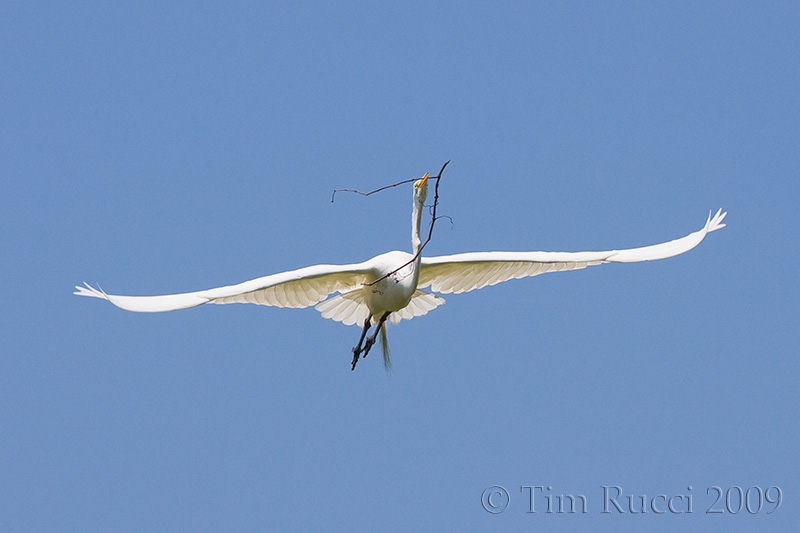
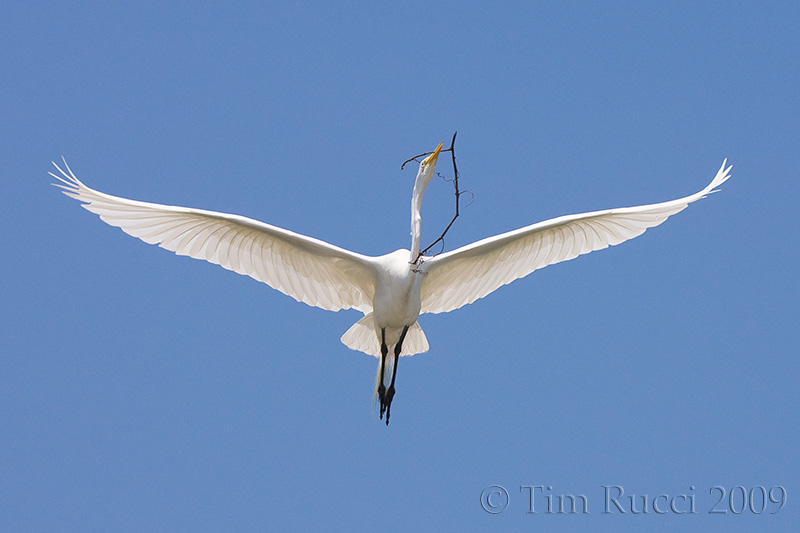
Below is a flight sequence of a great egret flying to the nest with a stick. I watched as the bird tore the branch from a tree, and then prepared to fly back to the nest. I like the first and last shots the best. It's interesting to watch as the bird springs off the tree and spreads its wings to take off.

#66627 - 66631 Great Egret flight sequence
66628
66629
66630
66631