Showing posts with label NASA. Show all posts

Wednesday, May 18, 2011

Space Shuttle Endeavour - STS 134 Final Mission

Program notes: Click on any photo to see a larger version.  Prints are available from a link to my web page posted at the bottom of this entry.

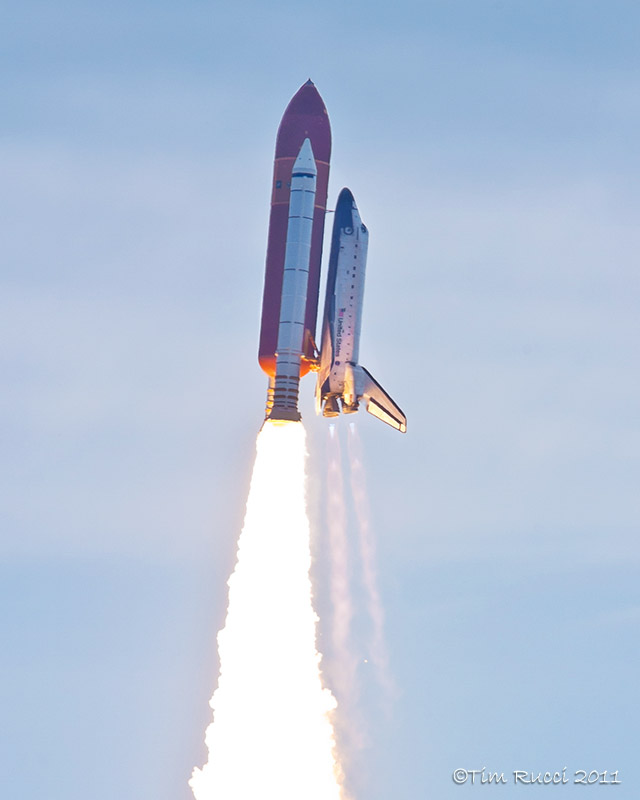
The story continues.  I managed to get back down to the Cape for one last chance to see Space Shuttle Endeavour launch on it's final journey, and everything went fine with the shuttle lifting off on time at 8:56am Monday.  I have just chocked one more item off my 'bucket list'.

On this visit, I was at the "turn basin" viewing site, which is a few hundred yards in front of the VAB Building, approximately 3 miles from the launch pad. This is the closest I've ever been to witness a shuttle launch.  On previous outings, my best attempts had come from the NASA Causeway, which is about 6.5 to 7 miles south of the launch pad.  One advantage viewing it from the turn basin is the smoke plume from the solid rocket boosters does not obstruct your view as it does from the Causeway.

Due to the low cloud cover, the shuttle was gone in just about 22 seconds from the time it lifted off.   Usually I am able to follow it through my lens and photograph the solid rocket booster separation, which does not happen until well beyond 2 minutes into the flight.  On this occasion, we could not see the shuttle at all after it ascended above the first cloud layer.
So this time it was over quickly.  We arrived at around 5:30am and staked out a spot to shoot from within the relatively small area that was roped off for spectators, then we waited about 3.5 hours to view the launch.  This launch was spectacular.  It's much more exciting from this distance, and the ground felt almost like an earthquake as the loud rumble from the shuttle shook everything in sight.  Light was not the best for photography, with the sun about 20 degrees to our right and up roughly 30 degrees off the horizon at launch time.  But the low cloud cover actually helped a bit to cut down on the lens flare I had been seeing through the lens prior to when the clouds rolled in.  At least we were not shooting into direct sunlight, which would have made it next to impossible to get any decent photos. 

I owe a special note of thanks to Cindy's cousin, David Turko who obtained the NASA pass and then invited us to join him and his sister Patty for the launch.  We had a thoroughly enjoyable weekend which also included a boat cruise at sunset Sunday, when we took advantage of some fantastic soft light to do a photo shoot with David's better half, Liz.  You may see some of those images in my nest post.

While waiting for the launch we visited with folks we met, and we monitored the light.  As the conditions constantly changed we discussed camera settings in hopes that everyone would be able to get properly exposed photos.  Exposures can be tricky, especially if one is used to shooting in aperture priority or shutter priority mode.  I avoid those settings and shoot manual exposures so that the bright flame of the solid booster does not affect the metering of the camera, and therefore change the exposure.  I have seen many people ruin photos by not taking this into account.  For anyone who may have been unfortunate it that regard, I have made prints available from a link at the bottom of this post. 

During our wait we especially enjoyed meeting Alyson and 3 of her friends, who we learned all who work for the American Cancer Society.  After I lifted my hat revealing my bald head, and told them I was fighting non-hodgkins lymphoma, we ended up having a lot to talk about, and they were all very helpful and supportive.

I am disappointed that the shuttle program is coming to a close, and there is no other program ready yet to go behind it.  This is also going to be devastating to the central Florida economy as all the NASA employees begin to loose their jobs over the next month or two.  

I cannot help but believe there is enough fat and waste in our federal budget that could be cut in order to provide funding for projects such as NASA.  Our space program over the years has resulted in many discoveries and innovations that have led to scores of products we use in our every day lives, such as teflon used to make cookware, and many, many others.  It is a shame that a program that has been so vital to us is now dying due to lack of funding and what I believe are misguided priorities. 

A larger variety of photos of this launch can also be seen on my main web page here:
http://www.pbase.com/tim32225/sts134_endeavour  along with the availability to purchase prints.


Tuesday, October 19, 2010

Photographing the International Space Station


Ever since my curiosity led me to try photographing the International Space Station as it flew overhead one evening in June, I've had the desire for closer images with more detail than I got on my first attempt. Using the NASA website, it's easy to tell exactly when the ISS fill fly over any location you enter, and NASA's "skywatch" program calculates the times when it will actually be visible.  These are always in times of darkness, or in the early morning or late evening when light from the sun illuminates the space station in the dark sky.  Usually the biggest deal breaker to getting photos is the weather.  You need a clear sky with few clouds or ideally no clouds to get in the way.

This morning was one of the best opportunities yet for photography.  At it's closest point, the ISS was only going to be 221 miles overhead at exactly 6:44:52am.  It would come into view from the Northwest about 800 miles away, and be visible to the naked eye a little over 2 minutes prior to passing at its closest distance.  After passing almost directly overhead (89 degrees from my location) it would be visible for another 2 minutes or so as it sped away toward the Southeast. 

This morning I slept through my alarm and luckily got outside with my camera gear just in time to see it approaching.  Usually I find the moon and set my camera focus on it to get a good 'infinity' focus setting, and then switch to manual focus to shoot the ISS, being careful not to touch the focus ring on my 500mm lens.  Today I was rushed and there was no moon in sight so I had to use autofocus and hope for the best. 
Looking through a long lens and teleconverter at high magnification, it is difficult to even find the bright dot streaking across the dark sky, even though it is clearly visible to the naked eye.   And trying to get the camera to auto-focus on it under these conditions is iffy at best.

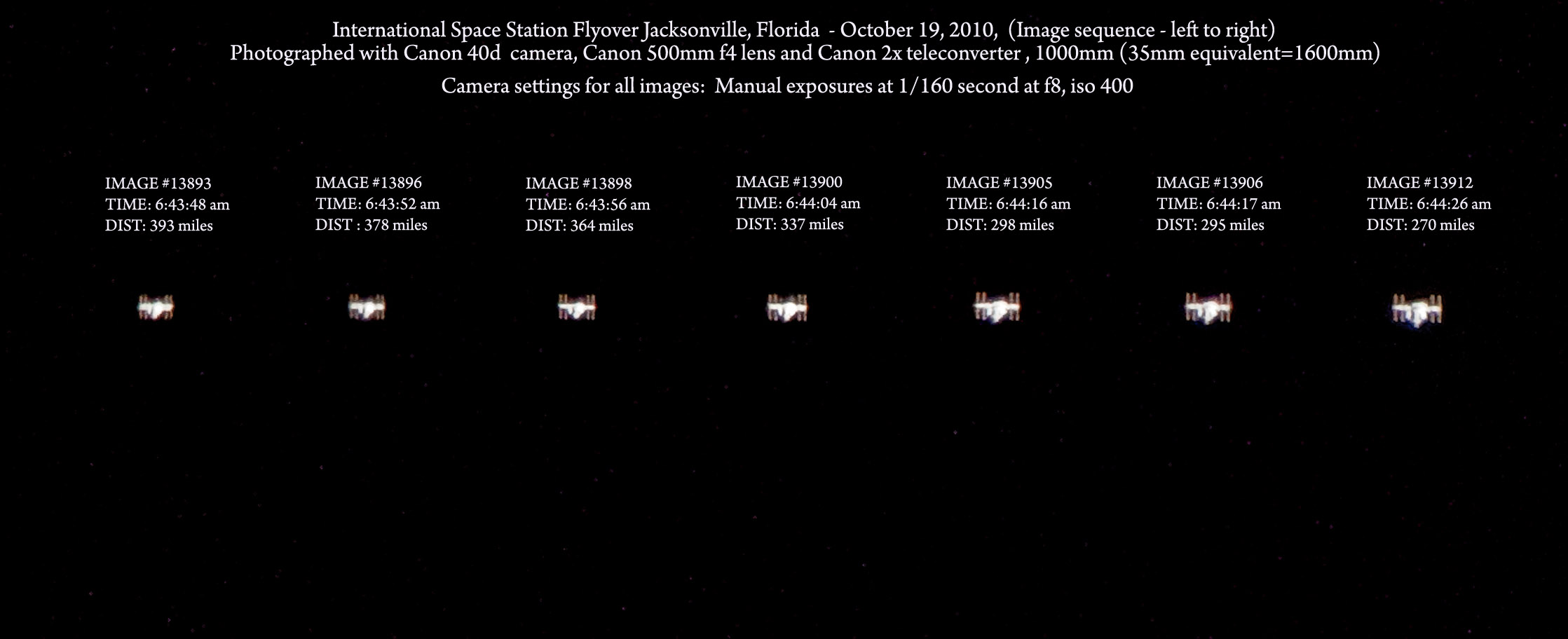
This morning I managed to get photos of the space station approaching, but unfortunately I lost it after it got closer than 270 miles away. When I found it again through the lens, I shot more photos as it sped away, but none of them were properly focused.   The solar arrays are clearly visible in the images of the ISS approaching but still not as close as I had hoped, since I was unable to get a shot of it when it was at its closest distance. 

(Click on the image below to see a full size composite showing 7 images of the ISS as it passed over this morning)


Distances listed in the image are calculated using tables from NASA's skywatch program, and interpolating the distances between the 20 second intervals listed.  Before doing this, I synchronized the time setting in my camera with an atomic clock to be sure time time stamp on each image was accurate.  This allowed me to determine the distance in each photo referencing the NASA charts.   You can clearly see that each successive image of the international space station is slightly larger than the previous one, since it is getting closer in each frame.   Even though it is difficult to keep the ISS in the viewfinder even at 1000 mm, I have pretty much decided that I need to stack teleconverters to get even more magnification if I ever hope to get a closer shot.  This will make it even more difficult to find in the viewfinder, but if I succeed the image will be 40% larger.

Monday, May 17, 2010

The Final Voyage of Space Shuttle Atlantis


I was fortunate once again to get tickets to view a shuttle launch from the NASA Causeway, and this one was absolutely spectacular.  The weather was almost perfect and although it was very hot, we had a very nice breeze that made the long wait very pleasant.  This was the final launch of Space Shuttle Atlantis on Friday May 14, which was taking supplies to the International Space Station.  

Although this is the 3rd launch I've witnessed from the NASA Causeway, they never get less exciting.   It was difficult to get good photos prior to the launch this time because there were visible heat waves making the view through the camera a little bit wavy as Atlantis sat on the launch pad.


As the countdown gets down to around 6 seconds, you can watch the shuttle's main engines fire and try to get a few photos before the solid rocket boosters fire and the smoke plume completely blocks the view of the space shuttle for people viewing it from the south.

The next trick is to be ready to get more photos as the shuttle emerges from behind the smoke.  

It's not until about 30 seconds after launch that you actually hear it, since we are slightly over 6 miles away. But once you hear it, you also feel it, and the rumble as it climbs skyward is something that everyone should get to experience.


The shuttle climbs just a short distance before it begins to roll to the side.


Only about 2 minutes into the flight, the solid rocket booster engine separation occurs and the shuttle continues into orbit on it's own three engines.  In the photo above, you can see the puff of smoke when the booster engines separate from the space shuttle. 

In the  photo below, you can see the solid rocket boosters completely separated from the shuttle as it continues onward.  The bright white dot below and to the right of the solid rocket boosters is the flame coming from shuttle's three main engines as it flies away from us.  This photo is a 100% crop from the actual image.


This is the last scheduled flight of Space Shuttle Atlantis.  Unless the US Congress does something to extend the program, the only way it will fly again is possibly as an emergency backup to one of the two remaining shuttle flights by the other orbiters.

Thursday, April 29, 2010

Roseate Spoonbills

One bird that seems to usually be pretty elusive for me is the roseate spoonbill.  I don't see a lot of them very often, and usually when I do the chances of good photos are slim.  When the birds are roosting, the backgrounds are almost always too cluttered so the best chance at a keeper is usually a flight shot.   This presents a whole different set of challenges because it seems that I seldom get many opportunities at flight shots either.  Even when I do, everything has to be just about perfect to get a decent photo.   The light needs to be in the right direction, and a small amount of flash should be used to partially light up the underside of the wings to balance the ambient light hitting other parts of the bird.  If all these factors are in place, then the challenge is to capture a good flight pose and also get a sharp, well focused image.    The majority of my attempts end up in the recycle bin due to one or more of the items mentioned above not being just right, but most often due to just not capturing an attractive pose.


On my most recent outing, I hooked up with a friend who was visiting Florida from Texas and we set out to try and get some flyer shots.   I had some decent opportunities with various bird species, including two chances where a roseate spoonbill flew close by.   I am only including the spoonbills in this post and all of these flight shots came from the same series.    In the image above, the bird was flying to the left and preparing to bank back toward the right. 


As the bird came back around to the right, I was fortunate to get a shot with a full wingspread.  Although the flash did not fire, I got a little bit lucky that the wings were back lit enough to prevent the underside from being too dark.   When I checked the exif data on this series of photos, I was surprised when I noticed that flash did not fire on any of them.   Thinking back, I remember changing my flash batteries at one point after discovering they were spent.  I must have shot this sequence prior to that time.  I must remember to watch that indicator more closely from now on as I believe some fill flash would have helped these images.  

As yet, this species has not nested this far north in Florida. But folks around here are hopeful that they may start soon as some nesting behaviours have been observed in St. Augustine.

In a bit of unrelated news, I was fortunate to get NASA Causeway tickets again for  the launch of Space Shuttle Atlantis on May 14.   So if all goes well and there no delays, I am hoping to get some better images of a shuttle launch in a couple weeks.  This will be the last flight of space shuttle Atlantis, and after this there are only 2 more launches left in the entire shuttle program.  I'm sad to see the program end.

Monday, April 5, 2010

The Launch of Space Shuttle Discovery sts-131

The Challenge of Photographing a Pre-Dawn Launch

Early this morning we drove down to Cape Canaveral to watch the launch of Space Shuttle Discovery.  We arrived at 3am to allow time to board a bus and set up our cameras on the NASA Causeway for the scheduled 6:21 am launch.   The launch was originally set for the afternoon of March 18th but due to cold weather in Florida, the preparations to the launch vehicle could not be completed in time for that date.  Because the shuttle launch has to be synchronized with the orbit of the International Space Station, the launch time gets 25 minutes earlier for each day it is delayed.   That's how we ended up with a pre-dawn launch, which is much more challenging to photograph. 

Today we were fortunate that everything went very smoothly and the weather cooperated very nicely as well.  Discovery lifted off right on schedule at 6:21am.   It was a nice cool morning approximately 60 degrees, which is what I consider perfect weather.  

Below is a chronological sequence of launch photos.  There were over 20 images in this series but I am only showing 5 of them.  The camera settings I used were vastly different for the first few photos, before the shuttle cleared the launch tower.  Once it cleared the tower and the huge flame from the solid rocket boosters became visible, I had to raise the shutter speed from 1/100 second to 1/640 second to prevent the photos from being completely washed out.  Since I knew the smoke plume would billow out toward us and momentarily block our view of the shuttle after the solid rocket booster ignition, I used this 1 to 1.5 second interval to adjust my shutter speed.   I was ready when the shuttle emerged from behind the smoke and I had the right settings thanks to a good friend from the Marshall Space Flight Center in Montgomery, Alabama who advised me early this morning.  Thanks, Joby!
[ click any photo to enlarge ]

Ignition of Discovery's 3 main engines.


Flaming up


Firing Solid Rocket Boosters (here comes the smoke plume)


Discovery emerges from behind the smoke plume.


The photo below shows the International Space Station as it flew overhead 17 minutes before the shuttle launch.   I snapped a few photos as it passed between us and the moon, getting both in the frame. 

[click photo to enlarge]


Finally, here's one that Cindy snapped right before the launch.  Since we were in total darkness, I  look like deer in someone's  headlights from the camera flash.

Additional images can be seen HERE.


Tuesday, November 17, 2009

Launch of Space Shuttle Atlantis

Yesterday I had the opportunity to view the launch of the Space Shuttle from the NASA Causeway, and it was one of the most exciting things I've ever witnessed. I had seen several launches before, but never from this close. My normal viewing site was always the rooftop of a business on US Highway 1 in Titusville, which according to Google is just a smidgen over 13 miles from the launch pad. But after getting lucky enough to purchase tickets for this launch, I was only 6 miles away.

The day started out very cloudy and I was skeptical that it would even launch as my brother and I were driving down from Jacksonville. It's about 2 1/2 hours drive and we hardly saw any blue in the sky most of the trip. The forecast was for a 70% chance of favorable weather and we kept hoping the clouds would blow past before the 2:28pm launch time. As luck would have it that's exactly what happened, and Atlantis was headed up toward the international space station exactly on time after a picture perfect liftoff. This was a welcome change for me personally, because the last time I had causeway tickets, I made 4 trips to Kennedy Space Center only to have the launch scrubbed all 4 times.

For viewing from the NASA Causeway visitors are required to arrive well in advance, with arrival times being assigned to everyone who is lucky enough to purchase tickets. There is quite a crowd of people and the arrival times are staggered so that everyone does not arrive at the same time. Our arrival deadline was 11am for the 2:28pm launch, but we arrived around 9:30.

The image above is heavily cropped to show the detail. But the images in the flight sequence below are the full width of the original image, but most of them have been cropped in the other direction only enough to create an 8x10 aspect ratio. The close up images were shot with a 300 f2.8L IS lens and Canon 2x extender on a 40d body, and the wider shots were done with a 100-400 and 28-135 lens on my Mk2N. I'm always reluctant to use the 2x extender but it usually works out ok on the 300 f2.8.

Additional images can be seen on my website here.

For a look at a night launch, check out The Launch of Space Shutle Discovery


Monday, March 16, 2009

The Launch of Space Shuttle Discovery

After several delays, Space Shuttle Discovery finally lifted off yesterday to transport the last solar array to the international space station. The launch was orginally scheduled for March 7th, but was delayed twice due to technical problems.Photographing a shuttle launch is something I have wanted to do, and I took this opportunity to make another attempt at it. This was a trickier task than a day launch because in very low light the exposure changes dramatically when the shuttle engines ignite, and even more so when the shuttle clears the launch tower and the entire flame is soon visible. The last time I attempted to photograph a launch was STS-117 in June 2007 and that was a day launch.
The biggest challenge to getting good photos is finding a place to shoot from that is close enough. The perferred viewing spot is the NASA causeway, which is on the grounds of the Kennedy Space Center. It sits directly south of the launch pad and offers a view over water from only about 6 to 7 miles away, depending on your position on the causeway since it angles from northwest to southeast. But the problem is getting tickets, which has proven to be very difficult. They are distributed in a lottery of sorts, which is usually only announced an hour or so before it takes place. The price for tickets varies from about about $50 and $100 per person and they must be obtained either by phone, or over the internet. Once the sale starts, typically all tickets are gone in only 2 or 3 minutes. So it takes a bit of luck to get them. Since I was not able to obtain tickets for the causeway, I was forced to shoot from an area off Highway US1, in Titusville. I was on a rooftop of a building that according to Google is about 13 miles from the launch pad. Below is a view from this spot, made at 840mm, using stacked teleconverters. Due to the difficulty in shooting with multiple teleconverters, I removed one of them before shooting the launch, so the launch photos below are shot at 600mm. (Click on any image for a larger view) On this attempt, I was shooting with a 300mm f2.8 lens and 2x teleconverter on my Canon 1D Mark2N camera. It was somewhat windy and my lens was moving around in the wind, which made it even more difficult to get decent photos. From 13 miles away, even on a clear day there is some haze that degrades the image quality. Yesterday was no exception, and from the rooftop where I was shooting, I could not even see the launch pad without either looking through binoculars or through my camera lens. Since I wanted to get some wide shots as well as close-ups of the launch, I had my other camera with a 70-200 f2.8 lens hanging at my side while my main camera with the larger lens was mounted on a tripod. I had planned to use a cable release with the tripod, but due to the wind I abandoned that idea since it made more sense to stabilize the rig with my hands and press the shutter in the normal fashion.

As launch time approached, it was getting darker a lot faster than I had anticipated. With a scheduled launch time of 7:43pm, I thought it would still be light since it was just after sunset. But soon I discovered that if I followed the light meter in the camera, the shutter speed I would get was only around 1/30 second at f5.6. Knowing that it would get very bright as soon as the shuttle lifted off, I decided to start out shooting at 1/60 and f5.6, so I would at least have a chance of getting photos without blurring.
As the countdown on the radio got inside 10 seconds to launch, I got ready but did not notice the first spark until the smoke plume was extending out from the base of the rocket. So I fired my first shot later than I would have wanted. But it seemed like no big deal since I did not really have enough light anyway. I knew that things would be a lot brighter in just a few seconds. I fired several shots as the shuttle moved upward and finally cleared the launch tower, and I continued to shoot as it climbed skyward. The sky turned from blue to gold as the shuttle rose higher. It was very bright - too bright for the settings I had chosen, so I quickly dialed my shutter speed up to 1/200. This was even before the bottom of the rocket flame was visible above the launch tower. I continued to shoot at this setting and as the shuttle rose higher and was about to fly out of the frame, I hurried to remove the quick release plate that was holding my rig to the tripod so I could take some hand-held shots. As the shuttle climbed higher into the dark sky, I had to back down the shutter speed to 1/125 to prevent underexposure. I continued at this setting until the shuttle got very high and small in the sky. As the spacecraft climbs out over the ocean to the east, it appears to be heading downward when viewed from the ground. This always makes an interesting photo, as the color of the smoke trail changes as the shuttle climbs away. The orange, white and pink colors make an interesting contrast against the blue sky. Only about 3 minutes into the flight, the two solid rocket boosers burn out and are separated from the main fuel tank and shuttle. I was happy to see that this was clearly visible even to the naked eye, so I was also able to capture it in a few photos. The rocket engines are still burning as they separate from the spacecraft, and it is interesting to watch as they begin to fall back toward the ocean as the shuttle continues to climb away. In the photo at left, the solid rocket boosters have already separated and can be seen falling away from the shuttle. As the shuttle climbs into the sky, there is a delay in the sound and also the rumble from the engines at the distance I watched it from. So you don't hear it or feel it until the spacecraft is well underway.

After it is all over, there is usually an interesting show of color left behind in the sky from the different colored smoke. The photo below was made at 7:51pm, about 8 minutes after the launch.
Overall I was not happy with the results I got on this attempt. The photos are OK but they are not as sharp as I would have liked, and it's difficult to do much better when shooting from such a great distance. Due to the low light conditions immediately prior to the launch, it was difficult to tell if I was properly focused on the launch pad, and it was also difficult to manually adjust the focus. But the main thing is that even if I had not gotten a single photo, it was still worth traveling to witness such an awesome event.

I highly recommend this experience for anyone who has not yet had an opportunity to witness a launch. There are only a few more shuttle launches left before the program terminates. After that, there will be a lull of several years before the next manned space flights.


For more shuttle launch info, please see my other article here: 
Photographing the launch of Space Shuttle Atlantis