Wednesday, February 23, 2011

Merritt Island National Wildlife Refuge


96987 - Great Blue Heron

I recently made a quick trip to Merritt Island National Wildlife Refuge and have finally gotten around to posting a few photos.  This great blue heron was standing in some grass near a pond and was in pretty good light.   I made quite a few shots but I like the head angle on this one the best.

Below is a full body shot of the same bird.  (Click on any image for a larger view.)
97008 - Great Blue Heron
And finally, one with a fish.


96969 - Great Blue Heron
 
I have never managed to get a really good shot of a belted kingfisher, and as of today I still haven't.  This one below is probably my best effort so far, but it is cropped from a larger image. These birds spook easily and it's very difficult to approach one to get a closer shot.


40-14265 Belted Kingfisher

The last two are a reddish egret and a tricolor heron.  


97137 - Reddish Egret


96848 - Tricolor Heron


Saturday, January 29, 2011

Reworking Old Photos


Night Heron in Flight (juvenile) 2005

[Click on any image for a larger view]
 It seems as software gets more and more sophisticated and one's editing skills improve, there is always a desire to go back and re-edit old photos.  On that topic, I often tell my friends that I don't think any of us will live long enought to go back and fix all of the images we'd like to fix.  But accepting that as reality, it's still fun to take some time now and then to dabble a little bit just to see the difference between our editing skills now, versus what they were back whenever.

I have been cleaning up some old computer files this weekend and deleting a lot of old images that I no longer feel are worth holding onto.  But in that process I stumbled across a few photos I couldn't resist taking time to rework.

I've been using Photoshop CS5 since it was released a last year and I believe it is absolutely the best upgrade Adobe has ever released in the CS line of software.  Adobe Camera Raw version 6 (raw image editor) is absolutely amazing compared to even the last version that preceded it.  The improvements in ACR alone make CS5 worth the upgrade price. 

The first image above of a juvenile night heron in flight, is a lucky shot I made back in 2005 with my first ever DSLR, a Canon 10d.  It typically could not focus fast enough to track a moving bird, but I got lucky on this attempt.  This is still one of my favorite shots of all the birds in flight I have photographed since.

Here are a few images I reworked today...


Tricolor Heron in breeding plumage, 2009
 

Red Shoulder Hawk, 2008


Yellow Crowned Night Heron, 2010


Meadowlark, 2008


Wood Stork (nest building), 2009


Great Egret with nesting material, 2009


Wednesday, December 22, 2010

Photographing the Lunar Eclipse

Early yesterday I morning went outside to photograph the lunar eclipse that was visible all across north America.  Although it was not my original plan, I ended up staying up all night and shooting over 400 images during the event. 

Since the moon was directly overhead for part of the time, I was unable to mount my lens on my tripod because it cannot be tilted that far upward without the long lens or the camera body hitting the top of the tripod.  Due to this, I hand-held my rig for a good portion of the time, and fired short bursts hoping to get a few sharp images out of each attempt.  Later when the moon was at a lower angle, I mounted my rig on the tripod and was able to just fire single shots every couple minutes.  One has to constantly adjust the camera aim since the moon actually moves rather quickly across the sky. 

What I have posted below is a sequence of 12 images that I believe summarizes what I saw over the four-hour period.   If you were not able to stay up all night, or if the weather prevented you from seeing it (as was the case in parts of the Western  United States) you can get a glimpse of what you missed below.

[Click on any image to see a larger view]
Image #1 of 12 - 12:58am


Image #2 of 12 - 1:59am


Image #3 of 12 - 2:15am


Image #4 of 12 - 2:39am


Image #5 of 12 - 3:22am


Image #6 of 12 - 3:46am


Image #7 of 12 - 3:52am


Image #8 of 12 - 3:56am


Image #9 of 12 - 4:14am


Image #10 of 12 - 4:32am


Image #11 of 12 - 4:53am


Image #12 of 12 - 5:03am

Tuesday, October 19, 2010

Photographing the International Space Station


Ever since my curiosity led me to try photographing the International Space Station as it flew overhead one evening in June, I've had the desire for closer images with more detail than I got on my first attempt. Using the NASA website, it's easy to tell exactly when the ISS fill fly over any location you enter, and NASA's "skywatch" program calculates the times when it will actually be visible.  These are always in times of darkness, or in the early morning or late evening when light from the sun illuminates the space station in the dark sky.  Usually the biggest deal breaker to getting photos is the weather.  You need a clear sky with few clouds or ideally no clouds to get in the way.

This morning was one of the best opportunities yet for photography.  At it's closest point, the ISS was only going to be 221 miles overhead at exactly 6:44:52am.  It would come into view from the Northwest about 800 miles away, and be visible to the naked eye a little over 2 minutes prior to passing at its closest distance.  After passing almost directly overhead (89 degrees from my location) it would be visible for another 2 minutes or so as it sped away toward the Southeast. 

This morning I slept through my alarm and luckily got outside with my camera gear just in time to see it approaching.  Usually I find the moon and set my camera focus on it to get a good 'infinity' focus setting, and then switch to manual focus to shoot the ISS, being careful not to touch the focus ring on my 500mm lens.  Today I was rushed and there was no moon in sight so I had to use autofocus and hope for the best. 
Looking through a long lens and teleconverter at high magnification, it is difficult to even find the bright dot streaking across the dark sky, even though it is clearly visible to the naked eye.   And trying to get the camera to auto-focus on it under these conditions is iffy at best.

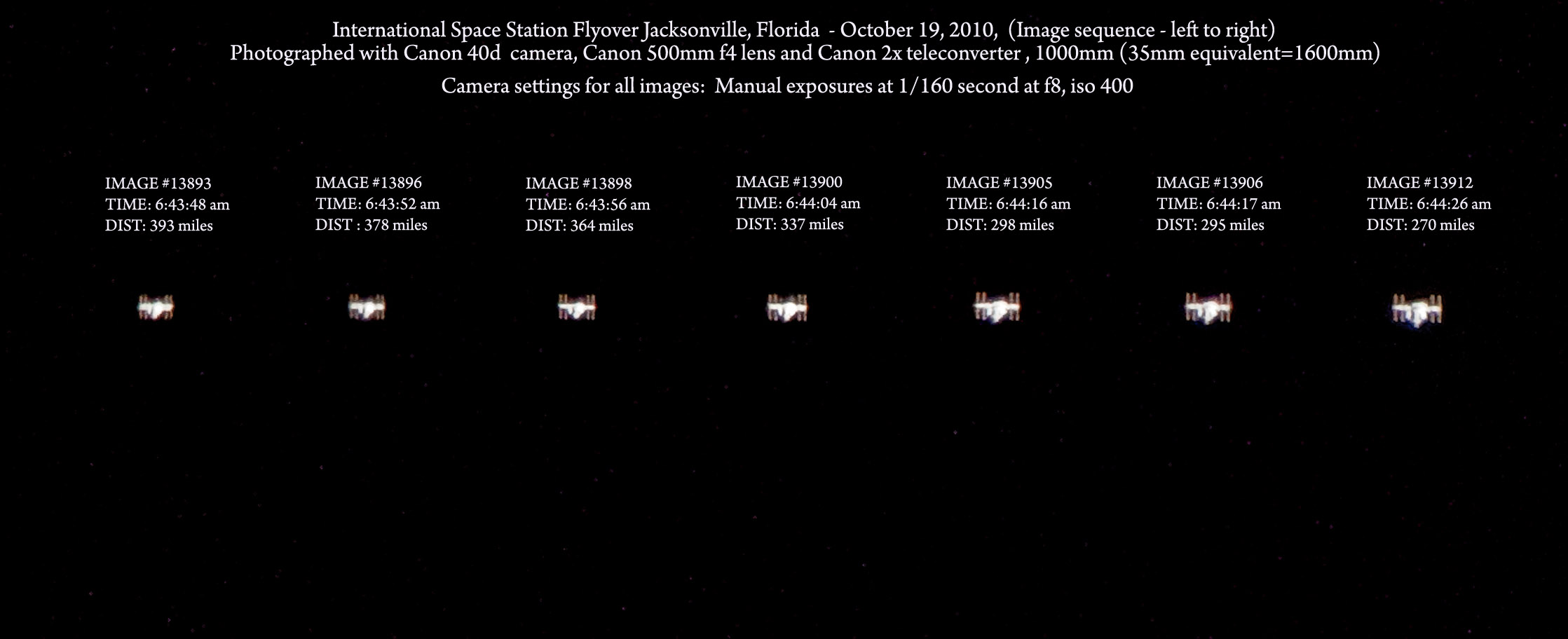
This morning I managed to get photos of the space station approaching, but unfortunately I lost it after it got closer than 270 miles away. When I found it again through the lens, I shot more photos as it sped away, but none of them were properly focused.   The solar arrays are clearly visible in the images of the ISS approaching but still not as close as I had hoped, since I was unable to get a shot of it when it was at its closest distance. 

(Click on the image below to see a full size composite showing 7 images of the ISS as it passed over this morning)


Distances listed in the image are calculated using tables from NASA's skywatch program, and interpolating the distances between the 20 second intervals listed.  Before doing this, I synchronized the time setting in my camera with an atomic clock to be sure time time stamp on each image was accurate.  This allowed me to determine the distance in each photo referencing the NASA charts.   You can clearly see that each successive image of the international space station is slightly larger than the previous one, since it is getting closer in each frame.   Even though it is difficult to keep the ISS in the viewfinder even at 1000 mm, I have pretty much decided that I need to stack teleconverters to get even more magnification if I ever hope to get a closer shot.  This will make it even more difficult to find in the viewfinder, but if I succeed the image will be 40% larger.

Friday, October 15, 2010

Camping in Denali National Park

Photographing Mt McKinley

Sunrise on Mt. McKinley - From Reflection Pond, Denali National Park
 
The highlight of my last few days in Alaska this year was camping at Wonder Lake, which is only 23 miles from Mt. McKinley.  We had driven almost all night to return to Denali from Seward, and this bought me a extra day since we had planned for Monday to be a travel day.  Arriving back in Denali in the early morning, we found that there was space available on the 2pm camper bus, so we unpacked our camping gear and dried out our tents, then repacked for Wonder Lake.  Since it rained the last day at Brooks Falls we had been forced to pack our tents wet before getting on a float plane to fly out.  We went for a good lunch before hopping on the bus. 


Panorama from Eielson Visitor Center - [Click to enlarge]

Wonder Lake is located at mile post 88 on the Denali Park Road - about 6 hours from the park entrance.  On a clear day there is breathtaking scenery along the way, especially at polychrome pass and at Eielsen Visitor Center. 

Our tents set up near Wonder Lake - Denali National Park
 
Upon arrival at Wonder Lake, we set up our tents and then cooked dinner before getting ready to hike up to Reflection pond to photograph the mountain.  We did not know it yet, but we were in for a special treat.   We heard there had not been a clear day there in the previous 3 weeks.  But we had arrived to a blue sky with a few puffy clouds that moved out during the evening leaving a clear view of Mt McKinley.  Our hope was to get photos with the reflections in the water.

The hike to the pond is about 2.5 miles, and it's mostly uphill.  We set out for the pond, carrying only minimal camera gear.  The bugs were pretty bad so we wore mosquito nets to keep them off our faces.   We arrived at the pond a little before 10pm, a good hour prior to sunset.  While we were at the pond, several others arrived, all with their cameras.  Most folks marvelled at the view, and I was no exception.   It is a rare sight to see the top of McKinley because it is usually shrouded by clouds.  Today it was clear and the lake that stood in front of us was icing on the cake.   We shot lots of photos and made plans to return around 4:30am to do it again when the light from the sunrise would first start hitting the top of the mountain.


Denali before sunset (10:24pm)

We arrived back at our tents around midnight planned to get back up at 3am.  We would need to take up camp and pack all our gear in the morning, before we could hike back up to the pond.  The hike had taken just short of an hour so we needed to budget at least that much time for the morning, since we would be carrying 40+ lbs of gear in each of our backpacks. 

In the morning the sky was clear, so we packed up our camping gear and left it at the bus pickup point and started out for the pond.  All went as planned, and we arrived at the pond at 4:30am.  We shot various photos of the mountain and had plenty of time to plan prior to the 5:08am sunrise.

We were fortunate that there was not much wind and this resulted on few ripples in the water to spoil the reflection.  I shot lots of photos, but my favorite one is the first one at the top of this post.  It was shot at 5:13am, just 5 minutes after the sunlight began to hit the top of the mountain.   It is repeated again below to show the progression from dark to light.


Pre-dawn McKinley (4:30am)


Just before Sunrise (5:01am)


Five minutes after sunrise (5:13am)


We started making our way back to the bus stop at 5:30am in order to catch the 6:30 bus.  Along the way, I couldn't resist photographing this scene, with the lush green meadow in the foreground and the mountain as a backdrop.


Denali through the meadow

We were back waiting for the bus with time to spare, and were able to relax on the long bus ride back.  I was really tired but it was well worth it.

This last photo was taken by a passerby on Monday evening. I'm the guy on the right, and the other guy is my friend, Ken Conger.   Ken is a park ranger at Denali National Park and he has captured amazing wildlife images all around Alaska and elsewhere.  You can see his website HERE.  


Tuesday, August 24, 2010

Grizzly Bears at Brooks Falls

It was very interesting and sometimes entertaining observing the behaviour of the grizzly bears at Brooks Falls.  Some bears seemed to be frequently catching salmon either swimming in the river or jumping at the falls while other bears seemed less fortunate.  And there seemed to be an established pecking order among the bears who were all trying to catch enough fish to satisfy themselves and fatten up prior to winter.   When one bear caught a fish, there was another particular bear that would chase after him and try to intimidate him into giving up the fish.  It seemed that this "bully bear" would almost always succeed in getting the fish away from the bear who had actually caught it.  This bear may have been too big and fat to be catching his own fish, but he got plenty to eat nonetheless by harassing all the other bears.
The tougher bears took the best fishing locations at the top of the falls, and were willing to fight other bears to keep their position.  There were usually lots of bears in the water in front of us.   One evening there were 19 bears there at the same time.


Soon we found ourselves giving the various bears nicknames based on their behaviour.  We were particularly entertained by a bear that I labelled 'beggar bear', who would frequently approach a bear that had just caught a fish.  But unlike the 'bully bear', beggar bear would approach within a foot or two and put his paws and head on the surface of the water, and gaze at the bear eating the fish, hoping the other bear would share some of the catch.  This bear was never aggressive and I never saw him try to steal the fish. This approach apparently worked because we often observed bears saving a small portion of their catch for him.

Another bear seemed to always stay in the swirling waters and bubbles just below the falls, and we appropriately named him "jacuzzi bear".


I tried to get a photo of a bear catching a fish, just before he closed his jaws on it. but I never exactly manged to get the shot I had in mind.  It was about 2 weeks past the peak of the salmon run, and fish were not jumping very often.  


As the bears would devour the fish, several gulls were always wading just a couple feet away, waiting for the scraps.  On one occasion, a gull went up and pecked away a piece of a fish while a bear was eating it.  That was one brave gull. 

Visiting Brooks Falls was nothing short of amazing.  I had never been here before, and I wouldn't hesitate to return if given the opportunity.


Monday, August 16, 2010

Grizzly Sow with Cubs

Katmai National Park, Alaska

Camping five days at Brooks Falls provided some great photo opportunities, but I think Thursday was the best day of all.  We had seen a sow with four cubs on the beach Wednesday morning, but not in time to try to get in position for photos.  Since my main photo goal on this trip was bear cubs, I was determined to be on the beach again early Thursday to look for them.  We headed to the beach first thing the next morning before going up to the falls, and sure enough she was there again with her 4 cubs. 

Seeing a sow with 4 cubs is a pretty amazing sight by itself because usually they have just 2 or 3.  Having the opportunity to photograph them was like a dream.  The sun was not yet popping through the cloudy sky at 6:45am, so I was forced to use make some compromises on camera settings.  I was fortunate to still get sharp photos.  

We watched as the mother left the cubs to look for fish in the lake, always keeping an eye on them to guard them from any danger.  At one point another bear approached, and in the top photo above it is this other bear that the cubs are watching.   Bears have been known to attack and kill cubs if the mother leaves them unprotected.  I believe this particular bear was quite capable of protecting her new family, and when she stood on her hind feet, she showed us just how big she is. 


The cubs are really cute as they play around and discover more and more of the world around them, and they are a joy to watch.


Dancing Bears?

It was really entertaining watching the cubs stand on their hind feet to get a better look at their surroundings.    They look like they are dancing.  


The next post will explore grizzly bears catching salmon in the falls.