
The roseate spoonbill is one of my favorite birds to photograph. It's fun to watch them fly and their pink color against a bright blue sky makes in interesting photograph. I had the occasion to see a few of them the last couple weeks and managed to get a few decent flight shots.
Typically I try to keep my shutter at 1/2000 second of higher for flight shots in order to eliminate any motion blur. If I manage to keep tracking the moving bird effectively, this gives me a chance to get a decent photo.
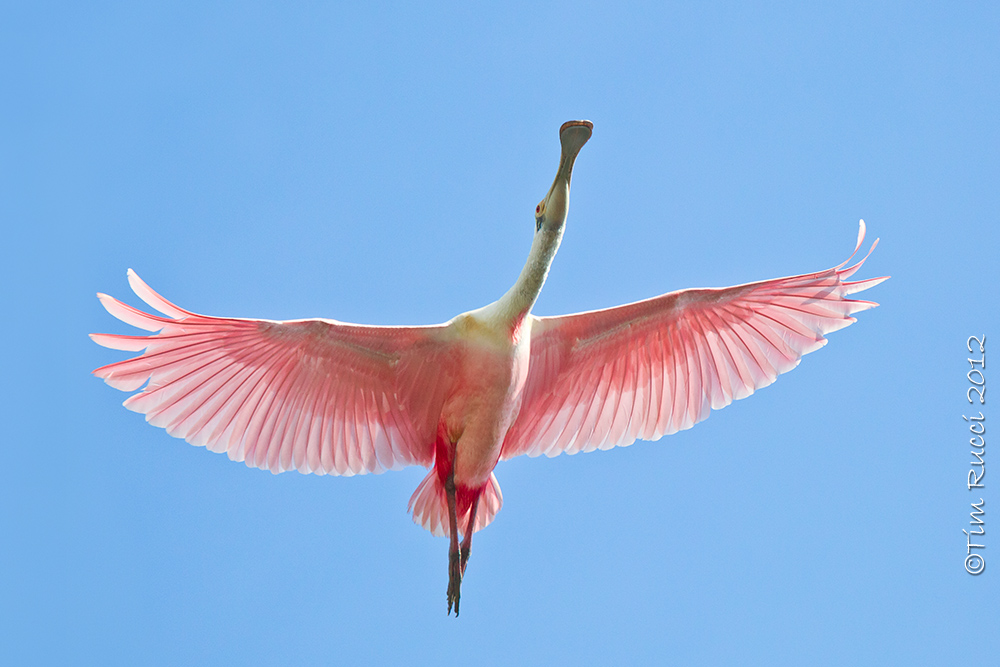
The photo above was the next image in the same series as the bird flew overhead. The wing position in this one is what I like. The image always seems more appealing to me with the wings in the full spread position. The curled primary feathers at the tip of the wings are an added plus.
One thing that makes it challenging to get an attractive photo of a bird in flight, is the fact that usually the underside of the wings is shadowed and therefore dark. The exception is late in the early morning or late evening when the sun is low, as sometimes the sun lights up the underside of the wing. That is the case only if the sun is behind you and the bird is flying toward the light. But even then, the chances of the underside of the wings being properly lit are not very high. For this reason, I almost always shoot with a flash and a 'better beamer' flash extender, which increases the range of the flash by about 2.5 times. In the image directly above, even though I used flash, the sunlight hitting the bird from above was still much brighter than the flash.
You can see how just a little different angle of light makes for a better photo in the example below. With the bird about 25 feet closer and banking slightly more, I am able to get more light under the wings from my flash.
I almost always shoot in full manual exposure mode because it offers several advantages over the programed auto exposure modes. First, in manual mode the camera does not alter the exposure according to the brightness of the scene. Allowing the camera to control the exposure us usually a deal breaker for birds in flight, because the brightness of the background changes dramatically if the bird suddenly flies away from the blue sky background and in front of a darker background of water or foliage. In auto exposure modes such as aperture priority or shutter priority, this would result in an overexposure of about 2 stops which means your image goes straight to the recycle bin.
Second, in the Canon system the external flash automatically fires at higher power when the camera is in manual exposure mode. (Flash acts only as fill in Av and Tv modes, resulting in a lower power flash). Using the better beamer and full power flash gives me over double the flash range. I can easily throw light from the flash on a bird 100 feet away using this method. The better beamer uses a fresnel lens and works by concentrating the light into a narrow beam, thereby increasing the amount of light that hits the target.
The images directly above and below are of younger spoonbills. The colors are more pale, and darken as the bird grows older.
For birds in flight, I typically use the center focus point, with the surrounding 6 focus points also activated in A1-Servo (focus tracking) mode. This gives me 7 active focus points in the middle of the frame to track the moving bird. Once I achieve focus, as long as I keep at least one of these focus points on the moving bird, the camera will track it and try to keep it in focus. Sometimes it's a little more difficult than it sounds.
I thought the leg kick in the photo above made it interesting. He was probably changing direction, as they usually keep both legs pointed straight back as they glide through the air. Below is the same bird just 7 seconds later as it flew past from right to left.
Some people photograph birds in flight by pointing the camera and firing off a burst of a half dozen or more shots. While my camera is capable of shooting 10 frames per second, I prefer to track the bird and instead fire off 2 or 3 shots at most, at just the right time. This results in a lot less work sorting through a bunch of extra photos. Also, if I am using flash, it cannot recycle fast enough to fire on every shot in a burst, usually only flashing on every 3rd or 4th shot if I'm firing at 10 frames per second. Sometimes I can get a good shot without the flash if light is perfect, but it's the exception. So I see firing long bursts as usually just a waste of battery power and memory space.
I sometimes fired bursts when shooting sports, because flash is not used and sometimes you miss the best shot in a series if you don't. But it has not been as useful for me when photographing birds.
Here is one final shot with the sun lighting up the wings and hitting the bird's eye just right. The flash did not fire on the photo below and this is the kind of exception I mentioned earlier, where you sometimes get a good shot of a 'flyer' without flash if the light is just right. [NOTE: Click on any image in this post to see a larger view of the bird]
 |
| #M4_03086 1/2500 @f5.6, iso 640, 400mm, distance = 74.7 ft Canon 1D Mark 4 & 100-400L IS lens |
Typically I try to keep my shutter at 1/2000 second of higher for flight shots in order to eliminate any motion blur. If I manage to keep tracking the moving bird effectively, this gives me a chance to get a decent photo.
 |
| #M4_03087 1/2500 @f5.6, iso 640, 285mm, distance = 59.3 ft Canon 1D Mark 4 & 100-400L IS lens |
The photo above was the next image in the same series as the bird flew overhead. The wing position in this one is what I like. The image always seems more appealing to me with the wings in the full spread position. The curled primary feathers at the tip of the wings are an added plus.
 |
| #M4_03058 1/2500 @f5.6, iso 640, 310mm, distance = 59.3 ft. Canon 1D Mark 4 & 100-400L IS lens |
One thing that makes it challenging to get an attractive photo of a bird in flight, is the fact that usually the underside of the wings is shadowed and therefore dark. The exception is late in the early morning or late evening when the sun is low, as sometimes the sun lights up the underside of the wing. That is the case only if the sun is behind you and the bird is flying toward the light. But even then, the chances of the underside of the wings being properly lit are not very high. For this reason, I almost always shoot with a flash and a 'better beamer' flash extender, which increases the range of the flash by about 2.5 times. In the image directly above, even though I used flash, the sunlight hitting the bird from above was still much brighter than the flash.
You can see how just a little different angle of light makes for a better photo in the example below. With the bird about 25 feet closer and banking slightly more, I am able to get more light under the wings from my flash.
 |
| #M4_03178 1/2500 @f6.3, iso 400, 210mm, distance = 35.4 ft. Canon 1D Mark 4 & 100-400L IS lens |
 |
| #M4_04948 1/2500 @f5.0, iso 400, 300mm, distance = 83.6 ft. Canon 1D Mark 4 & 300L f2.8 IS lens |
I almost always shoot in full manual exposure mode because it offers several advantages over the programed auto exposure modes. First, in manual mode the camera does not alter the exposure according to the brightness of the scene. Allowing the camera to control the exposure us usually a deal breaker for birds in flight, because the brightness of the background changes dramatically if the bird suddenly flies away from the blue sky background and in front of a darker background of water or foliage. In auto exposure modes such as aperture priority or shutter priority, this would result in an overexposure of about 2 stops which means your image goes straight to the recycle bin.
Second, in the Canon system the external flash automatically fires at higher power when the camera is in manual exposure mode. (Flash acts only as fill in Av and Tv modes, resulting in a lower power flash). Using the better beamer and full power flash gives me over double the flash range. I can easily throw light from the flash on a bird 100 feet away using this method. The better beamer uses a fresnel lens and works by concentrating the light into a narrow beam, thereby increasing the amount of light that hits the target.
 |
| #M4_03063 1/2500 @f5.6, iso 640, 260mm, distanced = 48.8 ft. Canon 1D Mark 4 & 100-400L IS lens |
The images directly above and below are of younger spoonbills. The colors are more pale, and darken as the bird grows older.
 |
| #M4_04871 1/2000 @ f5.6, iso 400, 170mm, distance = 35.4 ft. Canon 1D Mark 4 & 100-400L IS lens |
For birds in flight, I typically use the center focus point, with the surrounding 6 focus points also activated in A1-Servo (focus tracking) mode. This gives me 7 active focus points in the middle of the frame to track the moving bird. Once I achieve focus, as long as I keep at least one of these focus points on the moving bird, the camera will track it and try to keep it in focus. Sometimes it's a little more difficult than it sounds.
 |
| #M4_05029 1/2000 @f5.0, iso 400, 300mm, distance = 83.4 ft. Canon 1D Mark 4 & 300L f2.8 IS lens |
I thought the leg kick in the photo above made it interesting. He was probably changing direction, as they usually keep both legs pointed straight back as they glide through the air. Below is the same bird just 7 seconds later as it flew past from right to left.
 |
| #M4_05033 1/2000 @f5.0, iso 400, 300mm, distance = 58.3 ft Canon 1D Mark 4 & 300L f2.8 IS lens |
Some people photograph birds in flight by pointing the camera and firing off a burst of a half dozen or more shots. While my camera is capable of shooting 10 frames per second, I prefer to track the bird and instead fire off 2 or 3 shots at most, at just the right time. This results in a lot less work sorting through a bunch of extra photos. Also, if I am using flash, it cannot recycle fast enough to fire on every shot in a burst, usually only flashing on every 3rd or 4th shot if I'm firing at 10 frames per second. Sometimes I can get a good shot without the flash if light is perfect, but it's the exception. So I see firing long bursts as usually just a waste of battery power and memory space.
I sometimes fired bursts when shooting sports, because flash is not used and sometimes you miss the best shot in a series if you don't. But it has not been as useful for me when photographing birds.
 |
| #M4_05058 1/2500 @f5.0, iso 400, 300mm, distance =45.2 ft. Canon 1D Mark 4 & 300L f2.8 IS lens |
Here is one final shot with the sun lighting up the wings and hitting the bird's eye just right. The flash did not fire on the photo below and this is the kind of exception I mentioned earlier, where you sometimes get a good shot of a 'flyer' without flash if the light is just right. [NOTE: Click on any image in this post to see a larger view of the bird]
 |
| #M4_04949 1/2500 @f5.0, iso 400, 300mm, distance = 58.4 ft. Canon 1D Mark 4 & 300L f2.8 IS lens |


